New Zero-Day Vulnerability in Cacti Allows Remote Code Execution via Guest Access
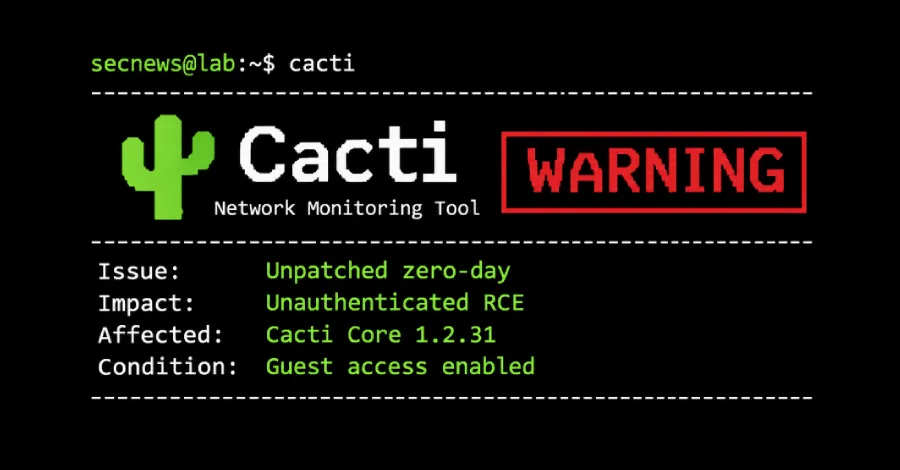
A critical zero-day vulnerability has been identified in Cacti, an open-source network monitoring tool widely used for monitoring network traffic and performance. This vulnerability allows attackers to achieve remote code execution (RCE) through a series of just four HTTP requests, exploiting guest access to the system. The exploit, which has been referred to as 4HTTP2SHELL and 4HTTP2ROOT, has not yet been assigned a CVE identifier, indicating that it is still in the early stages of disclosure and assessment.
The implications of this vulnerability are significant, particularly for organizations that rely on Cacti for network monitoring. The ability to execute arbitrary commands on the server without authentication poses a severe risk, as it could lead to unauthorized access to sensitive data, manipulation of network configurations, or even complete system compromise. Given that Cacti is often deployed in environments where network visibility and performance are critical, the potential for operational disruption is considerable.
The vulnerability was discovered by a security researcher who demonstrated a proof-of-concept (PoC) exploit. This PoC illustrates a clear path from an unauthenticated HTTP session to command execution on the Cacti server. The researcher noted that the exploit leverages the guest access feature, which is typically intended for limited user interaction with the system. However, this flaw allows malicious actors to bypass intended restrictions, effectively turning guest access into a vector for RCE.
As of now, there is no official patch or remediation available from the Cacti development team. The lack of a CVE identifier further complicates the situation, as it may hinder organizations from prioritizing their response to this vulnerability. Security teams are urged to monitor the situation closely and prepare for potential exploits, especially given the ease with which this vulnerability can be exploited.
The operational impact of this vulnerability could be extensive. Organizations using Cacti may find themselves at risk of data breaches, service interruptions, or even ransomware attacks if attackers leverage this RCE capability. The simplicity of the exploit—requiring only four HTTP requests—means that even less sophisticated attackers could potentially execute it, increasing the urgency for organizations to assess their exposure and implement defensive measures.
In light of this vulnerability, organizations should take immediate steps to mitigate potential risks. First, it is advisable to restrict guest access to Cacti instances wherever possible. Limiting exposure to unauthenticated users can significantly reduce the attack surface. Additionally, organizations should consider implementing network segmentation to isolate Cacti servers from critical infrastructure, thereby minimizing the potential impact of an exploit.
Furthermore, security teams should enhance their monitoring capabilities to detect unusual HTTP requests or patterns that may indicate an attempted exploitation of this vulnerability. Regularly reviewing access logs and implementing intrusion detection systems can help identify and respond to suspicious activities in real-time.
While the Cacti development team has not yet disclosed any specific timeline for a patch or further updates regarding this vulnerability, organizations should remain vigilant and proactive in their security posture. Engaging with the community and following updates from trusted cybersecurity sources will be crucial in staying informed about developments related to this zero-day vulnerability.
The discovery of this zero-day vulnerability in Cacti underscores the importance of maintaining robust security practices, particularly for open-source tools that are widely used in enterprise environments. As the situation evolves, organizations must prioritize their defenses and be prepared to respond to potential threats stemming from this critical flaw.